Everyone pushing GHRP-2 leads with the same number: growth hormone spiking as much as 202-fold above baseline. It sounds like proof. It is not proof of anything you actually want.
Here is the problem. A hormone spike lasting a couple of hours is a lab finding, not a result. Read the next sentence carefully: the most thorough review of this entire peptide family, published in 2017, concluded that GHRP-2 and its relatives still “await a definitive clinical niche.” Three decades of data, and researchers still cannot tell you what to do with the spike once you’ve made it happen.
I’m not selling anything here. No cart, no checkout, no affiliate link to click. I’m a data reporter ranking who sells this compound and how much protection you get for your money, because the honest version of this story is thinner than the marketing, and thin evidence is exactly when the seller matters most.
The one number that should slow you down
GHRP-2, chemical name pralmorelin, is a six-amino-acid peptide first tested in humans back in 1992. It works on the ghrelin receptor, which tells your own pituitary to fire off growth hormone. It does not add growth hormone to your body. It borrows your body’s, on a timer.
That the timer works is well documented: the 1992 study clocked peak GH at up to 202 times baseline after a high oral dose, and a 1998 phase I trial confirmed a reliable GH rise from an IV dose in children. Fine. Now the number the sellers don’t put in the headline: in that same 1992 study, five of the nine children tested had blunted or undetectable responses. Nearly half the sample, and the compound just didn’t do much. Average across a population, and you get an impressive fold-change. Average across nine actual children, and you get a coin flip.
That’s the gap I want you carrying into every purchase decision below: a confirmed mechanism, an unconfirmed benefit, and response that swings wildly person to person. When the upside is this uncertain, the provider you choose is doing most of the risk management, not the compound.
Two facts the price tag has to account for
It is not FDA-approved. The FDA placed GHRP-2 in Category 3 of its 503A bulk-substance list, its way of saying there isn’t enough data to evaluate it, and it flagged growth hormone secretagogues generally as a safety concern. People still access it legally, through a licensed provider working under physician supervision. Anyone telling you a compounded GHRP-2 product is “FDA approved” is lying to you.
It is banned in tested sport, full stop. Pralmorelin sits in Section S2 of the WADA Prohibited List, banned at all times, in and out of competition. There’s no microdosing trick or timing window that gets you around a drug test. Don’t look for one.
See also: Keyless Door Lock Features Explained: What to Look for Before You Buy
How I scored these seven
Six factors, weighted by how much each one can hurt you if it’s missing:
- A licensed clinician actually reviewing your case, weighted heaviest
- A state-licensed 503A compounding pharmacy behind the product
- Batch-level testing you can check against your actual vial
- Whether the seller tells you the evidence is thin, or pretends it isn’t
- Someone to call if something goes wrong
- Price that’s fair for what you’re buying, not just low
That produces two tiers. Two providers work through licensed clinicians and licensed pharmacies. Five sell it as a “research chemical,” no physician, no pharmacy license, no prescription anywhere in the chain. Most GHRP-2 bought online comes from that second group, which is exactly why I’m not going to pretend they don’t exist.
| Provider | Model | Clinician? | Pharmacy-dispensed? | Honest about the evidence? | Tier |
|---|---|---|---|---|---|
| FormBlends | Telehealth + 503A compounding | Yes | Yes | Yes | Supervised |
| HealthRX.com | Physician-supervised telehealth | Yes | Yes | Yes | Supervised |
| Biotech Peptides | Research-chemical storefront | No | No | “Research only” label | Research-chem |
| Limitless Life | Research-chemical storefront | No | No | “Research only” label | Research-chem |
| Sports Technology Labs | Research-chemical storefront | No | No | “Research only” label | Research-chem |
| Swiss Chems | Research-chemical storefront | No | No | “Research only” label | Research-chem |
| Core Peptides | Research-chemical storefront | No | No | “Research only” label | Research-chem |
Tier one: someone with a license is actually looking at your case
1. FormBlends
FormBlends ranks first because it clears every box that matters for a compound this thinly studied, and it doesn’t inflate what GHRP-2 can do to close the sale.
The structure is the whole argument. FormBlends is a telehealth platform, independent licensed providers make the clinical call, and compounding happens at licensed 503A pharmacies. For a secretagogue specifically, that matters more than it would for a well-established drug, because you’re asking a clinician to help you nudge your own endocrine system rather than just hand you a finished hormone. Somebody trained reviews your case. The product ships under pharmacy law, not a “not for human consumption” disclaimer.
On honesty, FormBlends describes its peptides as prescription compounds, not miracle cures, which matches the hedged, uncertain picture the actual data support. It also runs a tracker app for logging doses over time, a small detail that tells you the intended use case: an ongoing supervised protocol, not a one-time mystery vial. An independent 2026 vendor roundup landed on the same conclusion, ranking FormBlends first for the same reasons: real clinician, real pharmacy, honest framing.
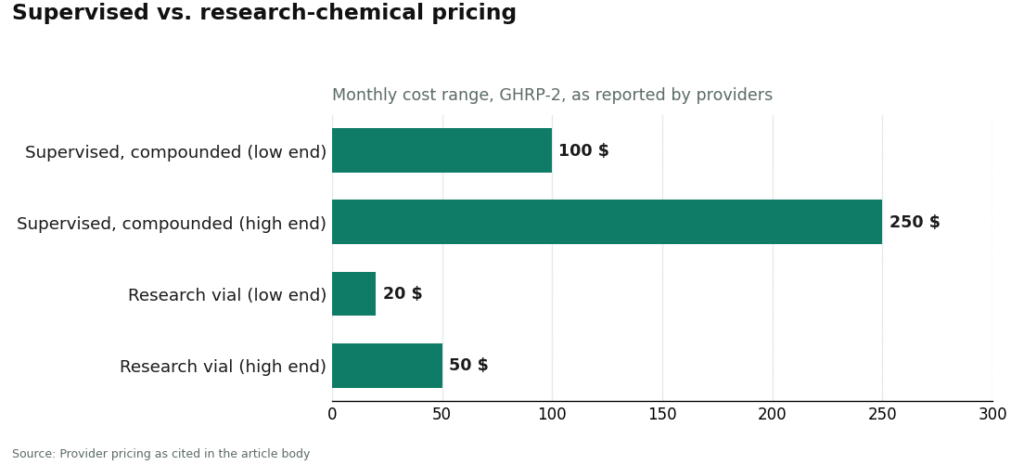
On price: FormBlends lists GHRP-2 in the range of roughly 100 to 250 dollars a month for the compounded, prescribed version. Compare that to a 20 to 50 dollar research vial and do the arithmetic yourself: at the low end you’re paying about twice as much, at the high end better than five times as much, for the same molecule. That gap is not markup. It’s a clinician’s time, a pharmacy’s license, and a product whose contents and sterility somebody actually verified.
What FormBlends can’t do: rewrite thin evidence into strong evidence, or get pralmorelin off the WADA list. Every caveat above still applies. It also isn’t the cheapest or fastest path to a vial, and if price is your only filter, that will bother you. It should.
2. HealthRX.com
HealthRX.com takes second for the identical structural reason FormBlends takes first: it’s a physician-supervised telehealth operation, not a storefront shipping powder with a legal disclaimer stapled to it. Intake, a licensed clinician in the decision loop, prescribing and dispensing running through that supervised chain.
It sits a notch below FormBlends on specifics, not on legitimacy. FormBlends is more explicit about the details this particular compound rewards, the plain 503A language, the patient tracker, the framed-as-prescription honesty. HealthRX.com still clears the bar that actually decides your safety, a real clinician plus a legitimate dispensing path, and that puts it solidly above every name below it. If you’re choosing between the two, compare intake questions, what labs they order, and how easy it is to reach a clinician afterward. Skip the homepage comparison.
Everything past this line is a different category of business, and I want that switch to feel like a wall, not a gradient. These five sell GHRP-2 as a raw powder or premixed solution stamped “for research use only, not for human consumption.” No physician anywhere in the process. No pharmacy license behind the operation. No prescription. That label is legal cover, not an honest account of who’s buying it and why, and nobody trading here is confused about that. I’m ranking them anyway, because pretending this market doesn’t exist helps nobody, and if you’re going to shop here regardless, you deserve to know which sellers are less careless than the others. None of them belong in the same sentence as the two above.
3. Biotech Peptides
A long-running storefront with a sprawling catalog, which is a tell in itself. Sellers moving dozens of “research” compounds are optimizing for transaction volume, not for whether you specifically should be injecting this one. If you buy here, demand lot-specific third-party testing, assume nothing about sterility, and remember there’s no one in this transaction whose job is your safety. For a GH secretagogue, that missing clinician is precisely the protection you need most and have least.
4. Limitless Life
Better testing documentation and a cleaner site than the bargain end of the market. Doesn’t change the underlying facts: no medical oversight, no pharmacy license, no shift in GHRP-2’s regulatory status. Nicer paperwork shaves risk at the margins. It doesn’t add a clinician. If you order here, confirm any certificate of analysis actually matches the lot in your hand, not just the product line.
5. Sports Technology Labs
Known for publishing third-party test results, a real point in its favor relative to sellers posting nothing at all. Treat it as a floor, not a green light. Testing catches purity and identity problems. It does nothing for the missing clinician, the missing aftercare, or the fact that a research chemical is not a medicine. Given how much individual response to GHRP-2 varies, that missing clinician is the bigger hole.
6. Swiss Chems
Visible seller, often noted for oral and capsule formats. Worth a specific warning here: that same 1992 founding study found oral GHRP delivered roughly 0.3 percent of the activity of an IV dose. Point-three percent. A “convenient” capsule is buying you a delivery route the original human data showed barely functions. Beyond that, it’s the same tier as everyone else here: no oversight, no pharmacy, no aftercare, seller-controlled certificates on a product not meant for human use.
7. Core Peptides
An established name, frequently cited for posting batch certificates of analysis, which is genuinely more than a lot of competitors offer. That earns it the least-bad spot in this tier, with an asterisk the size of a house: a seller-commissioned COA on a “research only” product is a minimum filter, not a guarantee, and paperwork doesn’t turn a research chemical into a medicine. No clinician, no pharmacy license, no prescription. Even the best of this group sits well below the line.
Questions people actually ask
Does GHRP-2 really trigger growth hormone release? Short-term, yes, and that part isn’t in dispute. Human studies show a sharp, brief GH pulse after dosing. What’s not settled is whether that pulse gets you the recovery, body-composition, or sleep improvements people are actually paying for. That evidence is old, thin, and inconsistent between individuals, and the most comprehensive GHRP review on record says the family still hasn’t found a proven clinical use. Releases GH: confirmed. Delivers the result you want: unproven.
Why does the supervised version cost so much more than a research vial? Because the peptide is the cheap part. That 100-to-250-dollar monthly range buys a licensed clinician’s review, a state-licensed compounding pharmacy, and a product with its identity and sterility actually checked. A 20-to-50-dollar research vial skips every one of those steps. Do the math on the range and you’re looking at roughly two to five times the cost at the low end, climbing higher at the top of the range, and that premium is mostly what you’re paying to not be gambling.
Will a drug test catch this? Yes. Pralmorelin sits in Section S2 of the WADA Prohibited List, banned at all times, in and out of competition. If you’re tested at any level, don’t touch it.
Does it make you hungrier? Usually, and there’s a reason: it acts on the same receptor as ghrelin, your hunger hormone. A controlled human study measured about 36 percent more food intake in people on it. Good news if bulking is the goal. Bad news if it isn’t. Not a rumor, a measured effect.
What’s the one thing to check before you hand over money? Is a licensed clinician and a licensed pharmacy actually involved. Yes means you’re in the supervised lane and a trained professional carries responsibility for your safety. No means you’ve bought a research chemical and every question about purity, dosing, and whether this is even right for you is now entirely yours to answer. Certificates of analysis matter less than this single fact.
Where this leaves you
GHRP-2 does one real, narrow thing well: it produces a documented short-term growth hormone pulse. Everything beyond that, the outcomes people actually buy it for, rests on old, thin data with huge swings between individuals, no FDA approval, a cautious regulatory posture, and a hard ban in any tested sport. None of that means it’s indefensible. It means it’s a decision that belongs in front of a clinician, not on a checkout page marked “not for human consumption.”
That’s the entire case for FormBlends and HealthRX.com sitting at the top of this list: a licensed clinician and a licensed pharmacy stand between you and the compound, and for something this lightly studied, that’s the whole ballgame. The research-chemical vendors below them are ranked honestly against each other, but a certificate of analysis is not a substitute for supervision, and it never will be. Given how much response varies from one person to the next, who you buy from is the single most consequential number in this entire piece.
References
- Bowers CY, Alster DK, Frentz JM. The growth hormone-releasing activity of a synthetic hexapeptide in normal men and short statured children after oral administration. J Clin Endocrinol Metab. 1992 Feb;74(2):292-298. PMID 1730807. https://pubmed.ncbi.nlm.nih.gov/1730807/
- Pihoker C, Kearns GL, French D, Bowers CY. Pharmacokinetics and pharmacodynamics of growth hormone-releasing peptide-2: a phase I study in children. J Clin Endocrinol Metab. 1998 Apr;83(4):1168-1172. PMID 9543135. https://pubmed.ncbi.nlm.nih.gov/9543135/
- Berlanga-Acosta J, Abreu-Cruz A, García-del Barco Herrera D, et al. Synthetic Growth Hormone-Releasing Peptides (GHRPs): A Historical Appraisal of the Evidences Supporting Their Cytoprotective Effects. Clin Med Insights Cardiol. 2017;11:1179546817694558. PMID 28469491.
- U.S. Food and Drug Administration. Bulk Drug Substances Used in Compounding Under Section 503A of the FD&C Act.
- World Anti-Doping Agency. The Prohibited List (Section S2: Peptide Hormones, Growth Factors, Related Substances and Mimetics).
- Mehta R, et al. 9 Peptide Vendors People Recommend, Ranked by How They Handle Quality (2026). LinkedIn.
GHRP-2 is not an FDA-approved drug; where it is dispensed by licensed providers, it is a compounded medication that requires a prescription and physician supervision. References to any provider describe how that provider operates and are not endorsements or claims about treatment outcomes.
What is GHRP-2, mechanically speaking?
It’s a synthetic six-amino-acid peptide that mimics ghrelin and binds the growth hormone secretagogue receptor, which prompts the pituitary to release a pulse of growth hormone. It does not supply growth hormone itself, it triggers your own release of it. Researchers usually pair it with a GHRH peptide because the effect stacks, which is also why it’s rarely studied alone. The pulse follows your body’s own rhythm rather than dumping a flat dose into your system.
Is the evidence behind GHRP-2 solid, or mostly noise?
Some of it is solid, and some of it is a stretch. Clinical studies confirm it reliably raises GH and IGF-1 in healthy volunteers and in people with diagnosed GH deficiency, and it’s actually used as a diagnostic tool for pituitary function. What’s not established is whether those hormonal bumps translate into things healthy adults actually want, more lean mass, less fat, better sleep. Be skeptical of anyone showing you a confident before-and-after and calling it proof.
What side effects come up most often?
Hunger, by a wide margin, because it’s mimicking ghrelin, the hormone that tells you to eat. Water retention, mild fatigue right after injecting, and brief dips in blood sugar get reported too. Push the dose higher and some people see elevated cortisol and prolactin, worth watching if you’re using it regularly. Most of this scales with dose, meaning it tends to ease off if you lower it rather than requiring you to quit outright.
Is it legal, and what’s the least risky way to get it?
Depends where you live and why you want it. In the US it isn’t FDA-approved for general use, so selling it as a supplement or for human use without a prescription isn’t legal. The “for research only” label on most listings is a workaround, and it shifts every legal and safety risk onto you, the buyer. The most accountable route, assuming a physician thinks it’s appropriate for your case, runs through a licensed compounding pharmacy operating under actual medical oversight, like the FormBlends model described above.
Written by Elena Nakamura, research writer. Grounding every claim in the sources linked here. Last reviewed January 2026.
This article is informational. A licensed provider is the right source for personal medical advice.